

Is a custom abutment for a dental implant always better than stock?
Published on: 10/02/2026
One might assume that custom is always best, but our honest analysis suggests otherwise. The fact is, custom isn’t always king. For a straightforward posterior case with thick tissue and clean placement, a stock abutment performs just as well. However, there are particular cases where the use of a custom abutment may be absolutely crucial to the outcome.
A custom abutment for a dental implant is a patient-specific connector linking the implant to the final crown, shaped to the individual form, angle, and gingival contour of one patient's mouth. Stock abutments come from a fixed catalog of shapes and sizes, while custom abutments are designed and milled around one patient's anatomy using CAD/CAM technology.
That distinction only matters where the anatomy demands it: the esthetic zone, thin or unusual tissue, and implants that were not placed exactly to plan are where a custom abutment demonstrably outperforms a stock one. For instance, anterior cases with a high smile line or a thin gingival biotype make the stakes concrete. A stock abutment forced into that kind of case tends to leave a grayish shadow visible through the facial gingiva as the tissue thins, along with early mucosal recession around the implant neck. Such outcomes trace less to the implant or the crown than to a prosthetic component that was never shaped to that patient's anatomy in the first place.
In contrast, the custom abutment is the only component in the restorative chain shaped around a single patient's anatomy. It sits between the implant platform and the crown, and it determines whether the final restoration reproduces the emergence profile of a natural tooth or works against it.
Key features and clinical benefits of custom abutments
A custom abutment's clinical advantages are visible in peri-implant outcomes and on long-term radiographic follow-up. They fall into five categories:
- Tailored fit: The abutment is built around the patient's actual anatomy and gingival height, so the emergence profile reads as a tooth root rather than a generic cylinder seated in the socket.
- Improved esthetics: This matters most in the anterior, where custom zirconia or hybrid abutments avoid the dark, metallic shadowing that can show through a thin gingival biotype, an outcome patients with a high smile line notice readily.
- Better gum health: The design supports the surrounding soft tissue instead of working against it, supporting healthier peri-implant mucosa and reducing the opportunity for bacterial infiltration.
- More manageable cement removal: The margin can be set at or just below the gingival line, which reduces the risk of residual cement, a documented and preventable contributor to peri-implantitis.1,2
- Angulation correction: Where surgical placement did not land the implant exactly where the restoration needed it, custom geometry redirects the platform for a straight, functional crown without compromising the screw access channel.
Materials
Two materials account for the majority of custom abutment cases, and choosing between them depends on what the case demands.
Zirconia is the default for high-esthetic anterior work. It is tooth-colored, produces a favorable soft tissue response, and plaque adheres to a polished zirconia surface less readily than to most metal surfaces.
Titanium, specifically Grade 5 titanium (Ti-6Al-4V), remains the default wherever functional loads peak, on the strength of its fatigue resistance and its long clinical track record for biocompatibility.
Between the two sits the Ti-base hybrid: a zirconia mesostructure bonded to a precision-milled titanium base, combining ceramic esthetics above the tissue with a titanium-to-titanium implant connection below. Most modern anterior cases are now built this way.
Stock and custom compared
Stock abutments are prefabricated, cost less, and ship faster, but they are limited in shape, fixed in margin position, and unable to correct for angulation. A custom abutment costs more to produce, but the added control over fit, margin, and contour tends to pay for itself over the life of the restoration. That's especially true in the esthetic zone and on implants that were not placed exactly to plan.
How a custom abutment gets made
Digital workflows are now the norm, though analog impressions remain a valid option when execution is sound. Either way, the stages generally run as follows:
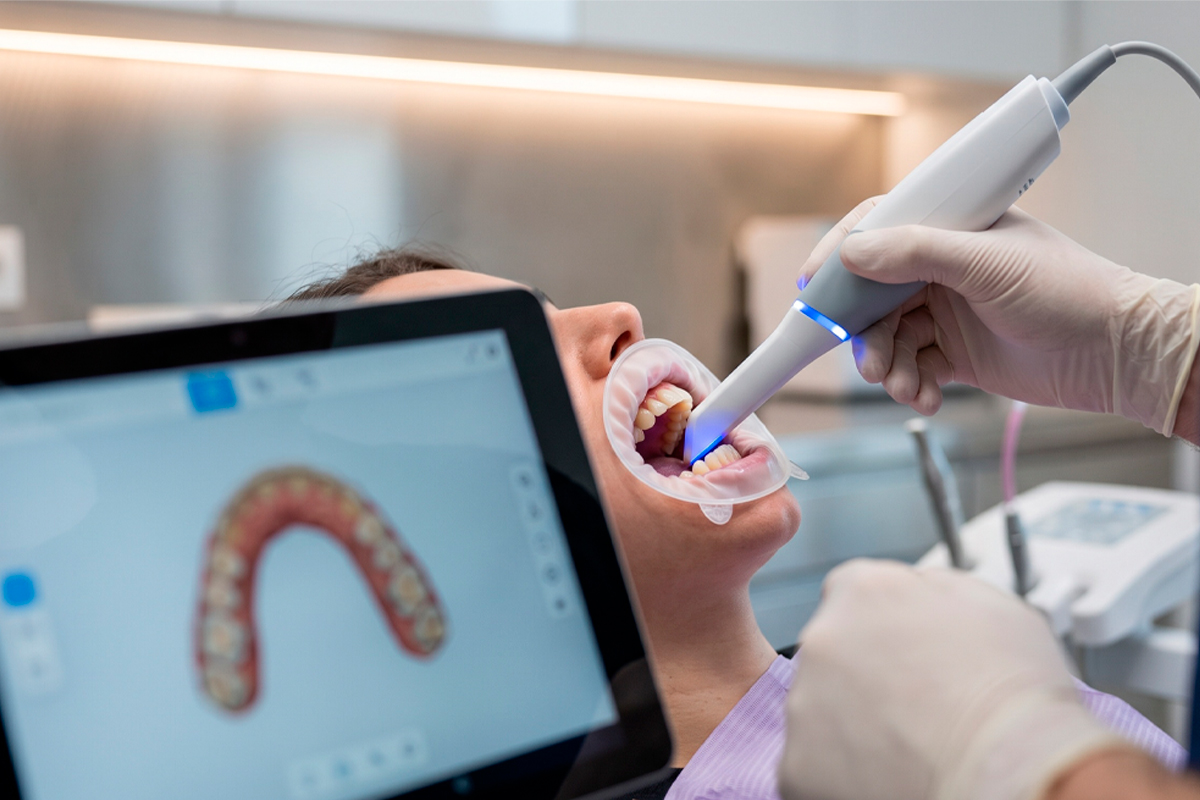
- Implant-level impression or intraoral scan: The clinician records implant position using an impression coping or a scan body after osseointegration has been confirmed, depending on the workflow.
- Model generation: A physical or virtual model comes from that scan data, including the soft-tissue contours at the implant site.
- CAD design: Margin position, emergence profile, angulation, and the relationship to the planned crown are all determined in CAD software.
- CAM milling: A titanium blank, or a zirconia one, is milled on precision CNC equipment before final finishing.
- Torque-controlled seating: The abutment is seated at the torque value specified by the implant manufacturer. Seating by feel, or skipping torque control altogether, compromises joint stability before the patient leaves the chair.
Precision in this workflow comes down to the accuracy of the digital library used during CAD design and the manufacturing tolerance of the finished part. A misfit of only a few microns at the implant-abutment interface is enough to break the hermetic seal and invite crestal bone loss, which is why IPD manufactures its scan bodies to a tolerance of ±5 μm, the level of precision the digital chain requires at every step.
The biological case for choosing custom, not just the esthetic one
Esthetics tends to dominate the conversation around custom abutments, but the more consequential question is whether the prosthetic component supports, or quietly undermines, the soft tissue seal protecting the implant over the following two decades.
The emergence profile drives tissue health
A natural tooth does not rise straight out of the gingiva. Real emergence follows a contoured cuff of soft tissue with a specific taper and circumferential relationship, and the custom abutment is the only component in the restoration capable of reproducing that geometry. Over-contouring places pressure on the tissue, which blanches and then recedes; under-contouring creates a food trap.
Good restorative outcomes tread the narrow line between those two failure modes. Stock abutments work within a single fixed geometry that rarely matches a given patient's biological width or planned restorative contour, while a custom abutment designed from accurate scan body data can be shaped to within fractions of a millimeter of the patient's actual anatomy.
Margin placement and the cement problem
Residual cement at the implant-abutment interface is documented in the clinical literature as one of the most preventable causes of peri-implantitis. A retrospective analysis of 129 implants found peri-implant disease in 85% of implants with residual cement, compared with 30% of implants without cement remnants and just 1.08% of screw-retained controls; every cemented implant in a patient with a history of periodontitis went on to develop peri-implantitis.1 A systematic review spanning 26 studies and 1,010 cemented restorations found peri-implant disease prevalence ranging from 1.9% to 75%, with 33% to 100% of those cases associated with excess cement.2
With a stock abutment, the margin sits wherever the manufacturer set it, and that typically drives the cement line deeper subgingivally than a clinician would choose. A custom abutment allows the margin to be placed where it can be reached and cleaned, usually at or just below the gingival crest, turning cement cleanup into a controlled step rather than a source of risk.
The micro-gap and long-term bone stability
The implant-abutment interface is measured in microns, not millimeters. Testing across 20 titanium and 20 zirconia implant-abutment units found average interface gaps of 12.38 μm for titanium and 5.25 μm for zirconia, and bacterial leakage was detected in every specimen no matter the material or torque value used.3 Anaerobic pathogens exploit gaps of that size; the crestal bone responds by receding from the site of contamination.
A precisely manufactured custom abutment, machined to match the implant connection geometry exactly, maintains the hermetic seal safeguarding the bone underneath over time. At that point, manufacturing tolerance stops being a procurement detail and becomes a clinical variable, one that shows up on the five-year radiograph.
When to choose a custom abutment for a dental implant
As already briefly discussed, not every case requires a custom abutment. A textbook posterior site with thick keratinized tissue and clean axial alignment can generally be restored well with a stock component. The indications where custom moves from preference to standard of care are reasonably well defined:
- Anterior esthetic zone restorations, particularly in patients with a high smile line or thin gingival biotype
- Implants placed at compromised angulations, where the screw access channel would otherwise emerge through the facial surface of an anterior crown
- Unusual tissue contours, including significant gingival asymmetry or deep tissue cuffs;
- Multi-unit restorations, where emergence profiles must be coordinated across adjacent implants; cases demanding precise margin control, particularly cement-retained restorations where subgingival cleanup needs to stay manageable
- Patients with a history of peri-implant inflammation, where added control over contour and margin position has a direct bearing on outcomes.
In each of these situations, the additional production cost of a custom abutment is generally recovered through fewer complications, lower remake rates, and longer prosthetic survival.
Manufacturing custom abutments across implant systems
Producing custom abutments across multiple implant systems, at volume, with a fit that holds up case after case, is a manufacturing problem before it's a clinical one. A single U.S. lab may handle case files from Nobel Biocare®, Straumann®, Zimmer Biomet®, and Dentsply Sirona® in the same week, which means stocking precision-machined interfaces and dependable digital libraries for every one of those systems.
CAD libraries matched to the hardware
Precision components are only half of the equation for a functioning digital workflow. The CAD library has to match the physical part it represents, or the milled abutment will not seat correctly, no matter how carefully it was machined. IPD's validated CAD libraries pair directly with its component catalog and are compatible with major CAD software, so designers work against geometry that reflects the actual hardware, from scan through delivery.
Materials, compliance, and component warranty
IPD's titanium components are manufactured from medical-grade biocompatible titanium. Its zirconia meets the strength and translucency specifications expected of esthetic-zone restorations. Production runs out of IPD's facilities in Barcelona, certified to the industrial and quality control standards required for distribution to more than 51 countries. Every IPD abutment and screw carries a lifetime replacement policy.
Custom abutments and peri-implant health over the long term
Restorative dentistry has shifted toward longer time horizons; five-year implant survival is no longer the benchmark that matters most, and patients increasingly expect two decades of service from a restoration. The custom abutment is where most of that long-term performance is decided. The crown, the cement, and the screw are all comparatively easy to revise if something fails. The abutment is the actual interface with the implant, and replacing it is invasive, costly, and not always successful. A custom abutment has to support the soft tissue, preserve the hermetic seal, and resist mechanical loading for decades, functions that are difficult to correct after the fact once the restoration is in place.
Custom abutments as the clinical standard
A custom abutment for a dental implant links it to the final crown, and how it performs comes down to how it is made. CAD/CAM production shapes the component to one patient's anatomy and gingival contour, rather than to a standardized geometry that only approximates a fit. That difference is where the clinical advantages originate — sharper esthetics, healthier tissue, cement cleanup that can actually be controlled, and long-term mechanical stability a stock component simply can't offer.
For posterior cases with ideal implant placement and thick tissue, stock abutments remain a sound choice. For anterior esthetics, compromised angulations, thin biotypes, and complex tissue contours, custom abutments are now the clinical standard. The range of indications keeps expanding as patient expectations rise. Delivering that standard depends on a manufacturing partner able to deliver precision, cross-system compatibility, and validated digital workflows from a single catalog. This is precisely the role IPD's range of precision abutments has been built to fill since 2004.
Frequently asked questions
When is a Ti-base hybrid preferred over a monolithic zirconia custom abutment?
A Ti-base hybrid is generally indicated wherever heavy occlusal or lateral loading is expected against a titanium implant. Solid zirconia grinding directly against titanium under load raises wear concerns, so the titanium base preserves a titanium-to-titanium connection at the implant interface while zirconia is retained only at the visible mesostructure.
How precisely can a custom abutment control margin depth compared with a stock abutment?
A custom abutment designed from CAD/CAM scan body data can place the margin, typically within fractions of a millimeter of the gingival crest. A stock abutment has a fixed margin position, which usually results in a deeper subgingival cement line and more demanding cleanup at delivery.
What implant-abutment microgap size is associated with bacterial leakage?
Testing across titanium and zirconia implant-abutment interfaces found average gaps in the range of 5 to 12 μm, and bacterial leakage was detected in every specimen tested no matter the material or torque value used, a process linked to peri-implant inflammation and marginal bone loss.3
Why does residual subgingival cement carry more clinical risk with stock abutments than with custom abutments?
A stock abutment's fixed margin position typically sits deeper subgingivally than ideal, making residual cement harder to detect and remove. A custom abutment allows the margin to be placed at or just below the gingival crest, keeping the cement line accessible. Retrospective and systematic-review data associate residual cement with a substantially higher rate of peri-implant disease than screw-retained, cement-free restorations.1,2
What clinical indications move a case from "stock is acceptable" to "custom is standard of care"?
Anterior esthetic zone cases, compromised implant angulation, unusual tissue contours, multi-unit restorations requiring coordinated emergence profiles, cement-retained restorations demanding precise margin control, and a patient history of peri-implant inflammation are the indications where custom abutments move from preference to standard of care.
References
- Linkevicius T, Puisys A, Vindasiute E, Linkeviciene L, Apse P. Does residual cement around implant-supported restorations cause peri-implant disease? A retrospective case analysis. Clin Oral Implants Res. 2013;24(11):1179-1184. doi:10.1111/j.1600-0501.2012.02570.x. pubmed.ncbi.nlm.nih.gov/22882700
- Staubli N, Walter C, Schmidt JC, Weiger R, Zitzmann NU. Excess cement and the risk of peri-implant disease - a systematic review. Clin Oral Implants Res. 2017;28(10):1278-1290. doi:10.1111/clr.12954. pubmed.ncbi.nlm.nih.gov/27647536
- Smith NA, Turkyilmaz I. Evaluation of the sealing capability of implants to titanium and zirconia abutments against Porphyromonas gingivalis, Prevotella intermedia, and Fusobacterium nucleatum under different screw torque values. J Prosthet Dent. 2014;112(3):561-567. doi:10.1016/j.prosdent.2013.11.010. pubmed.ncbi.nlm.nih.gov/24656409
Share this content